Facebook

Hazardous-Area PTZ Spec Selector

Hazardous-Area PTZ Spec Selector

Specifying surveillance for a tank farm, jetty or chemical unit comes down to matching the housing and the signal path to the site, not to the badge on the front of the unit. This selector walks through the hard variables behind a 2mp explosion proof camera decision — alloy choice, ingress protection, zoom reach and control protocol — then narrows the shortlist to the one housing and lens combination that fits your zone. Where pan, tilt and optical zoom all have to live inside a single certified enclosure, start with the explosion proof ptz camera specifications below and compare from there.

12x optical zoom5–60 mm autofocus lens
IP68 sealed304 or 316L stainless steel
ATEx / CNExCE and FCC also listed
2MP 12X Eplosion Proof Anti-Corrosion  Mini PTZ Analogue IR Camera

Scenario-to-Specification Router

Pick the sentence that describes your site, then check the specification it forces. Every route below ends in a concrete buying decision rather than a generic recommendation.

Confined skid, pump bay or loading arm

Specification to demandA motorized 5–60 mm autofocus zoom (12x) inside a mini PTZ body, with 0–355° pan and 0–90° tilt.

Why it mattersShort-throw zoom keeps a wide view for approach and a tight view for a flange or valve without moving the mount.

Buyer decision: one 12x mini PTZ can cover a bay that would otherwise need two or three fixed cameras.
Deck, jetty or salt-fog atmosphere

Specification to demand316L stainless steel housing rather than 304, with IP68 sealing and anti-corrosion treatment.

Why it mattersThe product page specifies 316L for maritime environments, where chlorides attack the cheaper alloy first.

Buyer decision: pay for 316L wherever salt spray, brine or chloride washdown is part of normal operation.

Brownfield plant with existing coax

Specification to demandOne port carrying four switchable signals — TV, AHD, CV and CVBS — plus UTC and RS-485 control.

Why it mattersThe field cabling stays where it is, and the camera is matched to whatever the recorder already accepts.

Buyer decision: confirm the recorder format before ordering, then reuse the existing cable route instead of re-pulling fibre.

Washdown bay or heavy dust

Specification to demandA wiper or lens-cleaning arrangement on top of IP68 sealing — and a written answer on whether it is offered.

Why it mattersNo wiper is listed for the featured model, so this requirement must be settled before the order, not after installation.

Buyer decision: if a wiper is mandatory, raise it during quotation so a suitable configuration can be scoped.

Model Comparison Matrix

The matrix only carries rows that match a current product page. Anything not stated on the page is marked as not listed instead of being estimated, so the table can be lifted straight into a specification pack.

Model Resolution Sensor Lens / zoom IR Housing IP Certifications Pan / tilt Control Signal Wiper
KDQ-EX-PTZ2012IR04N(A) 2 MP — 1920 × 1080 @ 25 fps (50 / 60 Hz) 2 MP Sony CMOS; the page also names a 1/2.9″ Sony323 CMOS — confirm the fitted variant on your order Motorized vari-focal 5–60 mm, 12x, autofocus 2 IR LEDs, up to 40 m Stainless steel 304 or 316L (316L specified for maritime use) IP68 ATEx / CE / FCC / CNEx 0–355° / 0–90° UTC & RS-485 One port, four switchable signals: TV / AHD / CV / CVBS Not listed

Marine-grade fixed and dome body styles from the same range are profiled further down the page, each linked to its own product page for the current datasheet.

The Four Decision Variables

Housing alloy, ingress protection, certification marks and zoom range are the four points where hazardous-area projects are won or lost. Here is how each one is read.

Is 2 MP Still Enough, and Will It Run on Coax?

Two objections come up on almost every hazardous-area RFQ. Both are settled by the signal chain rather than by the sensor headline.

For identification at the distance a mini PTZ actually works at — a valve bank, a manifold, a gangway — 1920 × 1080 at 25 fps remains a serviceable format, and it is the format this model delivers across 50 Hz and 60 Hz systems. The resolution that matters at the recorder is the one you still get after the stream has travelled the site's existing cabling, not the number on the box.

The stronger argument for this camera class is transmission. One port carries four switchable signals — TV, AHD, CV and CVBS — so the same unit can be matched to a new AHD recorder or to an older CVBS system without changing the camera. Control runs over UTC and RS-485, which means pan, tilt and zoom commands travel on the same legacy infrastructure the video does.

Where 4 MP IP becomes the better answer is a greenfield build with new structured cabling and a requirement for on-camera analytics or multi-stream recording. Where the cable trays are already full and the runs are long, the analogue route keeps the project in budget and inside the shutdown window.

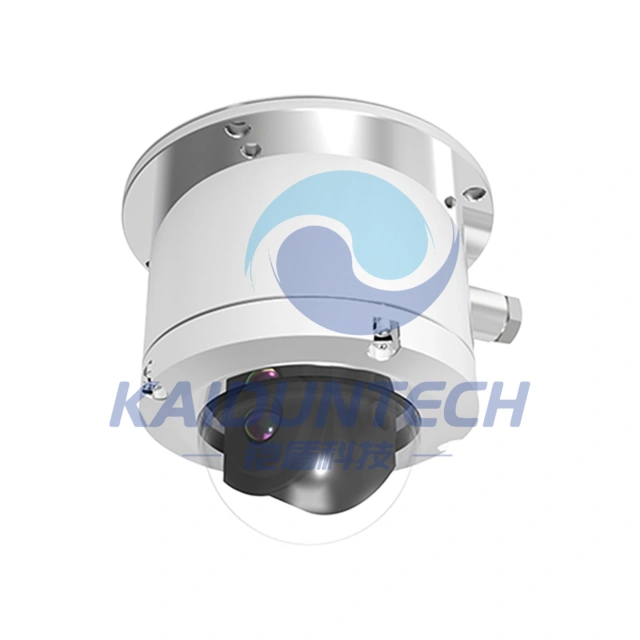
KDQ-EX-PTZ2012IR04N(A) explosion proof anti-corrosion mini PTZ analogue IR camera with 12x zoom

Featured Model: KDQ-EX-PTZ2012IR04N(A)

A 2 MP analogue IR mini PTZ built for hazardous and highly corrosive sites: stainless steel housing, IP68 sealing, 12x autofocus zoom and 40 m of infrared in one enclosure.

12x zoom IP68 ATEx / CNEx 304 / 316L
  • Motorized 5–60 mm vari-focal lens with autofocus
  • 2 MP 1920 × 1080 at 25 fps
  • 2 IR LEDs, night vision up to 40 m
  • Pan 0–355°, tilt 0–90°
  • TV / AHD / CV / CVBS on one port
  • UTC and RS-485 control
  • 2DNR / 3DNR / Sense-up / D-WDR
  • Day / night dual-mode imaging

Build the Shortlist, Then Get the Numbers

Send the site conditions and the format you need. ODM/OEM customisation is available for packaging, branding, logos and tailored designs, so project-specific builds can be quoted alongside standard units.

Related Reading

Three notes to help clarify product requirements before contacting the supplier.

How Coaxial Retrofit Cameras Reuse Cable Routes in Old Plants

Reusing the coaxial cable already installed in an old plant can cut retrofit work sharply, but only when cable condition, run length, and head-end compatibility line up.

Read article

IP68 Sealing in Stainless Steel Hazardous Area Camera Housings

IP68 tells you a camera housing survived dust and water testing, but the seal that earns it lives at gaskets, joints and cable entries.

Read article

OEM Hazardous Area Camera Manufacturing for Private-Label Brands

A private-label hazardous area camera program turns on three practical questions: how far the factory can customize, how the sample will be tested, and whether the first order can stay small.

Read article

Frequently Asked Questions

What information is shown for this product?

Review the product details, images, and specifications presented on the official product page.

Where can i check the intended application?

Use the application and use-case information published on the official product page.

Which specifications should i confirm before ordering?

Confirm the specifications and options listed for the exact product variant before placing an order.

Where can i check available options?

Check the official product page or ask the supplier about options shown for the selected product.

How can i request product information?

Use the official contact or inquiry path provided on the site.

What should i include in an inquiry?

Include the product page, intended use, required quantity, and any specifications you need the supplier to review.