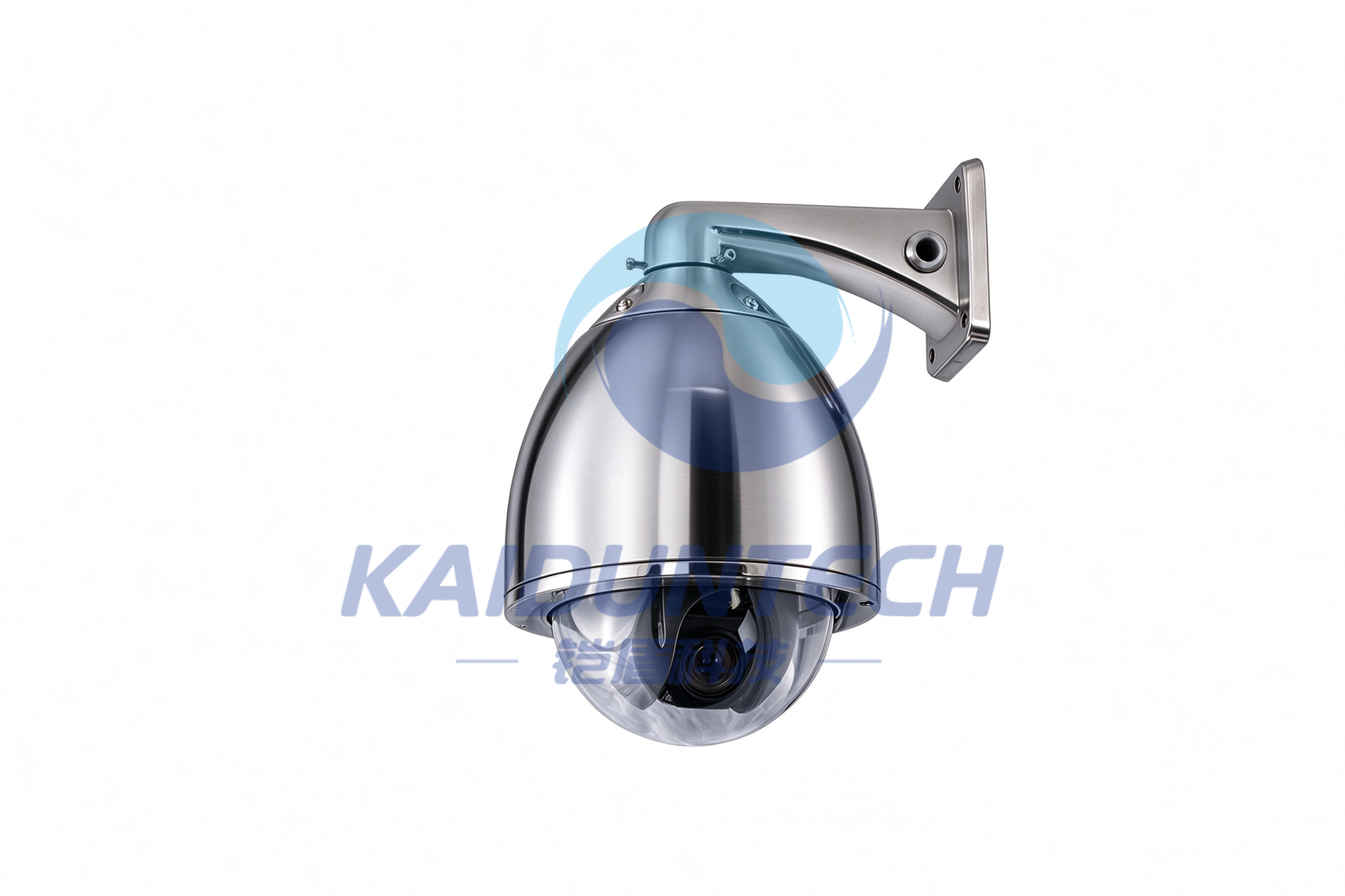
Explosion‑proof anti‑corrosion PTZ dome IP camera specially engineered for crane‑boom mounting. Built‑in spring shock‑absorbing damping structure, 360° continuous pan, ‑90°~0° tilt, 4MP 33× optical zoom, rich AI intelligent functions. 316L stainless‑steel / 304 stainless‑steel IP68 housing with full explosion‑proof certification. Designed for vibration‑intensive hazardous‑area cranes, offshore‑platform lifting machinery, delivering omni‑directional dead‑angle‑free monitoring for hooks, cargo and deck‑site operations.
Hazardous‑area crane and offshore lifting projects face multiple surveillance pain‑points:
KDQ‑EX‑PTZ403302(CR) solves above‑mentioned challenges. Integrated spring damping buffer assembly, certified explosion‑proof 316L stainless‑steel dome housing, 4MP 33× long‑range zoom, comprehensive AI analytics and open‑standard protocols. Realises shock‑resistant omni‑directional intelligent monitoring for hazardous‑area crane‑boom installations.
✅ Off‑shore Platform Hazardous‑Area Cranes: Platform‑mounted lifting cranes within gas & dust hazardous zones. Omni‑directional PTZ monitoring for hook lifting, cargo transfer and deck‑perimeter safety.
✅ Petrochemical Plant Hazardous‑Area Gantry / Overhead Cranes: Land‑based Zone 1/2 gas, Zone 21/22 dust classified‑zone cranes; track lifting operations, equipment status and personnel access risks.
✅ Off‑shore Support Vessel Hazardous‑Zone Lifting Machinery: Crane‑boom installation for OSV and chemical‑transport vessels; adapts to salt‑spray marine environment for cargo‑handling visual supervision.
✅ Coal‑Chemical Heavy‑Duty Lifting Equipment: Process‑area cranes in coal‑chemical hazardous zones, intelligent tracking for lifting targets and restricted‑zone intrusion early‑warning.
Purpose‑built for direct crane‑boom mounting. Supports full PTZ movement. Optional accessories: explosion‑proof junction boxes, stainless‑steel / rubber flexible hoses for complete crane‑on‑site wiring deployment.
| Item | Parameter |
|---|---|
| Image Sensor | 1/2.7” 4MP Progressive‑Scan CMOS |
| Optical Zoom | 33× optical zoom, focal 4.5‑148.5 mm |
| Minimum Illumination | Color:0.003Lux; B/W:0.002Lux (AGC ON) |
| PTZ Parameter | Pan: 0‑360° continuous, 0.1‑200°/s; Tilt:‑90°~0°,0.1‑120°/s; 255 presets |
| Damping Feature | Built‑in spring shock‑absorbing damping for crane‑boom installation |
| Smart Functions | Face capture, human‑body & vehicle‑pedestrian auto‑tracking, perimeter detection, people‑flow & density statistics, multi‑event alarm; privacy masking, ROI encoding |
| Local Storage | Micro‑SD card up to 256 GB, network‑break cache recording |
| Video Compression | H.265 / H.264 / MJPEG; Triple‑stream output |
| Protocol Support | ONVIF Profile G/T/S, GB/T28181, GA/T1400, API, IPv4/IPv6 |
| Power Supply | AC100‑240V, POE++; Max power ≤40W; POE++ max distance 80m |
| Explosion Grade | Ex II 2G Ex db op is IIC T6 Gb; II 2D Ex tb op is IIIC T80°C Db |
| Housing & Protection | 316L Stainless‑steel / 304 stainless‑steel, IP68, 2KV surge protection |
| Working Environment | ‑40℃ ~ +60℃, humidity ≤100%RH (non‑condensing) |
| Dimension / Weight | 240*240*650 mm; ≤27.5 kg |
| Installation | Specialised for crane‑boom mounting |
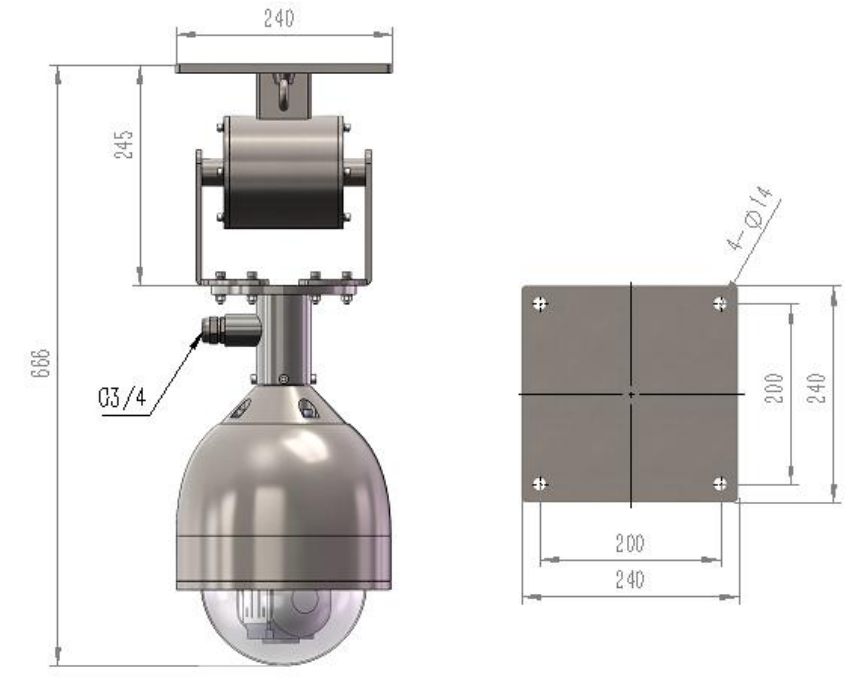
Deliverables: Datasheet, mechanical dimension drawings, explosion‑proof certificate copies and operation manuals for project submission and vessel‑safety survey.
Warranty Terms: 12‑month standard warranty for the complete unit. Extended warranty service is available upon separate commercial quotation. Faulty devices support factory‑return repair or replacement; remote technical commissioning guidance is provided. Complete technical‑document support for offshore‑vessel and land‑hazardous‑site projects.
Packaging & Logistics: Export‑grade wooden‑crate packaging. Supports EXW, FOB and other trade terms; optional accessories can be consolidated for one‑batch shipment.
Reminder: Crane‑mount explosion‑proof damping PTZ dome camera is special industrial‑marine safety equipment. Off‑the‑shelf stock cannot be guaranteed. Please arrange order placement ahead of new‑build or refit project schedule.
Case 1 | Off‑shore Platform Hazardous‑Zone Crane Intelligent Monitoring Project ‑Project Challenges: Lifting crane on offshore gas‑hazardous platform. Heavy vibration during crane operation; requires full‑range PTZ tracking for lifting hooks and cargo. Mandatory explosion‑proof certification for platform safety acceptance; need AI auto‑tracking and perimeter‑intrusion alarm functions, connect to platform existing VMS. ‑Solution: Multiple KDQ‑EX‑PTZ403302(CR) PTZ dome cameras installed on crane booms. Built‑in spring damping mitigates operating shock; configure preset tours, target auto‑tracking and intelligent alarm rules, deployed matched explosion‑proof junction boxes and flexible hoses. ‑Outcome: Realises stable omni‑directional intelligent monitoring under crane vibration. Operators remotely track hook‑cargo movement, trigger automatic alarms for restricted‑zone violations. Passed offshore‑platform hazardous‑area safety acceptance.
Case 2 | Petrochemical Plant Hazardous‑Area Gantry‑Crane Surveillance Project ‑Project Challenges: Zone 1 gas & Zone 21 dust‑classified gantry crane inside petrochemical plant. Vibration during lifting operations, requirement for long‑range zoom observation of lifting status and personnel‑density alarm for working zones. ‑Solution: Deploy KDQ‑EX‑PTZ403302(CR) explosion‑proof damping PTZ dome cameras, enable people‑density statistics and cross‑border detection functions. ‑Outcome: Reliable operation in corrosive hazardous‑plant environment. Reduces manual on‑site inspection frequency and fulfils project intelligent safety‑monitoring design requirements.
A: Purpose‑built for crane‑boom mounting, applicable for offshore‑platform / land‑based cranes within gas Zone 1‑2 and dust Zone 21‑22 hazardous locations. Full set of explosion‑proof certification documents can be provided for safety‑audit and vessel‑survey submission.
A: Internal spring shock‑absorbing assembly absorbs most vibration and mechanical impact from crane lifting / slewing, suppresses picture shake and protects internal components. It cannot completely eliminate extreme violent impact.
A: Supports face detection, human‑body / vehicle‑pedestrian classification & auto‑tracking, perimeter intrusion, people‑flow and personnel‑density multi‑level alarm. Hook tracking effect depends on scene lighting and target contrast conditions.
A: AC100‑240V and POE++ are supported. POE++ maximum cable transmission distance is 80 metres; long‑distance deployment recommends local AC power supply. Max power consumption ≤40 W.
A: Specially designed for crane‑boom mounting. Optional KDJ004 / KD‑EX07SS explosion‑proof junction boxes, stainless‑steel / rubber flexible hoses for crane‑site wiring protection.
A: Supports ONVIF, GB/T28181, GA/T1400 and API interfaces. Most mainstream surveillance systems can receive video streams and alarm events. Please confirm compatibility for highly customised platforms before ordering.
A: Custom‑order service is available for damping‑parameter tuning, interface modification and function adjustment. Please contact sales team for specification review, MOQ and lead‑time assessment.
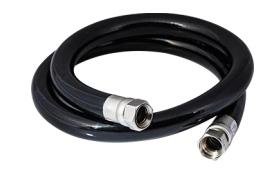
KDR‑1500 Rubber Flexible Hose
KDSR‑1500 Stainless Steel Flexible Hose
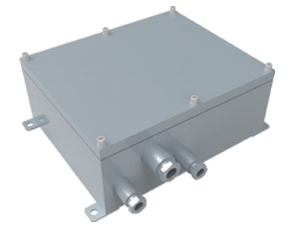
KDJ004 Exe Type Explosion Proof Junction Box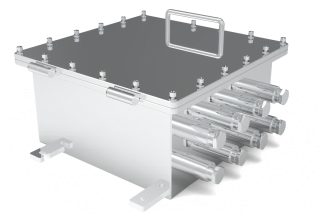
KD‑EX07SS Exd Type Explosion Proof Junction Box
The KDQ-EX-PTZ403302(CR) is a hazardous area crane camera: a 4MP pan-tilt-zoom dome built to ride on a crane boom inside a classified zone. What separates it from a standard explosion proof camera is the mounting assembly. The camera is sprung rather than bolted rigid, so the jolts of slewing and lifting reach the optics softened rather than direct. Dust and grime wipe off the smooth dome during a normal inspection round instead of building up in seams. We build it for offshore platform crane packages, petrochemical gantry and overhead crane bays, offshore support vessel deck cranes and coal-chemical lifting equipment — anywhere the crane itself sits inside Zone 1, Zone 2, Zone 21 or Zone 22. In daily use an operator drives it from a joystick or a VMS client. Saved presets jump between the hook block, the landing zone and the deck perimeter, while the analytics raise intrusion and crowding alarms without anyone watching the wall. Vibration smears a zoomed image. On a slewing crane a rigidly mounted PTZ loses detail exactly when the operator needs it most — during the lift, at full zoom. Repeated shock works on the hardware as well as the picture. Rigid mounts pass every jolt into the lens assembly and the circuit boards, and those failures surface months later. Compliance decides whether the camera can be fitted at all. Gas Zone 1-2 and dust Zone 21-22 locations need an ATEx certified camera and the paperwork behind it. Salt spray, chemical vapour and heavy dust attack ordinary housings, and a corroded seal is where water ingress starts. A fixed camera cannot follow a hook. Operators need the view to travel with the load and then cover the deck or the bay. Video-only monitoring depends on somebody watching. Without analytics, an intrusion or a crowd forming under a load is noticed after the fact. Closed protocols create a second project. A camera that will not join the existing recorder forces gateway hardware, extra configuration and a grey area over who supports what. Putting a PTZ on a moving boom is one of the harder explosion proof camera solutions to get right. A dome that pans and tilts is by design a camera full of moving parts, and a crane is a machine that shakes everything bolted to it. The damping assembly exists to make those two facts compatible. Explosion protection and corrosion protection usually pull against each other — sealed joints, thicker walls and stainless steel all add weight. Here they sit in a dome that still rotates continuously through a full circle and tilts to look straight down. The analytics run inside the camera. Decisions about intrusion, crowding or a tracked person are made at the boom, and the control room receives events instead of raw video it has to interpret. The unit speaks the protocols a control room already uses. It joins an existing recorder or VMS as a camera, not as a project. One mounting point covers the hook close-up, the load path and the deck or bay perimeter, which is the difference between watching a lift and watching a fixed slice of it.
The marking is dual: Ex II 2G Ex db op is IIC T6 Gb for gas and II 2D Ex tb op is IIIC T80°C Db for dust. In practice that is what allows the same ATEx certified camera to be specified for a Zone 1 platform deck and a Zone 21 coal bay, and it is the line an auditor will look for on the certificate. Housing material follows the site: a 316L stainless steel camera for offshore decks, chemical terminals and anywhere chlorides are present; 304 stainless steel for land-based process areas where the chloride load is lower and the budget is tighter. Ingress protection is IP68 and the supply and signal path carries 2 KV surge protection, which matters on a crane where the camera shares a structural earth with motors and drives. The window is a sealed dome and the cable enters through a threaded gland rather than an open knockout — entries like that are where water ingress usually begins on a deck-mounted camera. Every unit ships with a datasheet, mechanical dimension drawings, copies of the explosion-proof certificates and an operation manual. Those copies are the ones a safety auditor or vessel surveyor will ask for, so keep them with the installation record rather than in a file drawer ashore. The drawings are what the yard needs to fabricate the boom bracket and to check clearance before the camera arrives. Where an explosion proof camera goes into a project submission, we assemble the document set in the order the reviewing body expects and answer technical queries during the review.
Face capture and attribute extraction run on the camera, so a person entering the lifting area can be recorded as a face event rather than as an anonymous shape in the frame.
Human-body and vehicle-pedestrian classification separates the two, and auto-tracking keeps a selected target framed as it moves across the scene.
Perimeter analytics cover cross-border detection, area intrusion and loitering — the set that maps onto a crane exclusion zone or a deck perimeter.
People-flow counting and personnel-density statistics alarm at several levels, which is how a safety officer sees a crowd building under a suspended load before it becomes an incident.
Motion detection, occlusion detection and audio anomaly alarms cover the cases the object filters miss. Tracking a lifting hook is possible but depends on the scene lighting and on how much contrast the hook presents against its background: a bright hook against a dark hold tracks far better than a dark hook against a dark deck.
Video is encoded as H.265, H.264 or MJPEG, so the stream fits whichever profile the existing recorder supports. On the network side the camera supports ONVIF Profile G, T and S, GB/T28181, GA/T1400, an open API and IPv4/IPv6 addressing, which covers most industrial and marine VMS platforms without a gateway. For a site that already runs a recorder, this ONVIF explosion proof camera is added as a normal device: streams and alarm events appear in the client and preset control stays with the operator. Micro-SD storage up to 256 GB keeps a local record inside the camera, independent of the network. Network-break cache recording fills the gap when the link to the recorder drops, then writes the missing footage once the link returns. Triple-stream output lets the control room watch live while the recorder stores full quality and a remote user takes a low-bandwidth stream. Region-of-interest encoding spends bitrate on the part of the frame that matters — the hook, the walkway — and privacy masking keeps restricted areas out of the record. Alarm inputs and outputs, audio in and out and multiple serial ports give the unit a physical interface to a siren, an access controller or a third-party device on the crane.
Case one — an offshore gas-hazardous platform where the lifting crane shook hard enough that a rigidly mounted PTZ was unusable. Operators now follow hook and cargo movement from the control room, restricted-zone breaches raise an alarm automatically, and the installation passed the platform's hazardous-area safety acceptance. Case two — a petrochemical plant gantry crane in a bay classified Zone 1 for gas and Zone 21 for dust. The requirement was a Zone 1 Zone 2 PTZ camera for long-range observation of the lifting status, plus a crowding alarm for the working area. The damped PTZ was deployed with people-density statistics and cross-border detection enabled. It has run continuously in the corrosive plant atmosphere, cut the number of manual inspection rounds, and met the specified safety-monitoring design requirement of the project. Both projects started from explosion proof CCTV camera system solutions fitted around equipment the client already owned, and both were supplied with matched junction boxes and hoses so that camera, enclosure and wiring came from one specification. A platform crane works inside the gas-hazardous envelope of the deck, so the camera has to suit that classification before it is even considered. After that, the question is what it can show you. The lift is the main subject: the hook block coming down to the deck, the load leaving the deck, the swing out over the water. Continuous pan keeps the load in frame through the whole arc, and the long focal length makes the hook and slings readable from the pedestal. Between lifts the same unit runs a preset tour across the lay-down area, the walkway and the platform edge, so a single mounting point covers the routine round. Salt-laden air and wash-down water are the everyday conditions here. The 316L stainless steel camera housing and sealed dome are chosen for that environment, and the smooth exterior sheds salt instead of trapping it. Alarm events from the built-in analytics reach the platform control room over the existing network, so an approach at the deck perimeter arrives as an event on the VMS rather than as something someone has to notice on a monitor. Zone 1 gas and Zone 21 dust bays: the crane bridge and the process equipment underneath sit inside the classified area, so the camera is specified for the same zone as the crane. Long travel along the bay: store a preset at each pick-up station and each drop station, and the operator jumps between them instead of panning by hand for half a minute. Load path over pipe racks: the zoom range lets an operator check clearance between a suspended load and the rack structure before the load gets there. Crowding under the crane: people-density statistics give the safety officer a count and an alarm level for the working area rather than an impression. Bay entrances: cross-border detection raises an event when somebody walks into the lifting area while the crane is working. Remote inspection: at full zoom the camera can look at a valve group or a flange from the crane instead of sending a technician up for a visual check. Deck cranes on offshore support vessels and chemical tankers work in a hazardous zone that also moves. The camera mounts on the crane structure and covers the cargo hook, the deck crew's working area and the rail. Ship motion adds a second source of movement on top of the crane's own vibration. The damping assembly deals with the mechanical shock and electronic image stabilisation takes out what is left in the image, so the two work on different parts of the problem. Cargo-handling supervision is normally recorded. The local Micro-SD card keeps a copy on board even when the link to shore is down, and cache recording covers short network interruptions. Vessel wiring is finished with the matching Ex junction box and hose so the run from the boom to the deck box keeps its protection. Dust Zone 21 and 22 areas around coal and coke handling: the dust marking is the one that matters here, alongside the gas marking for the process side of the plant. Coal dust settles on everything, so the dome is wiped as part of the normal inspection round; a smooth stainless surface keeps that a quick job. Process areas swing between hot summers and hard winters — check the -40 to +60 °C working range against the extremes your site has actually recorded. Restricted-zone early warning: intrusion detection around the lifting area raises an alert before a person walks under a suspended load. Lifting-target tracking: the analytics keep a moving person or vehicle framed, which holds attention on the area that matters during a lift.
| Item | Parameter |
|---|---|
| Image sensor | 1/2.7” 4MP Progressive‑Scan CMOS |
| Optical zoom | 33× optical zoom, focal 4.5‑148.5 mm |
| Minimum illumination | Color:0.003Lux; B/W:0.002Lux (AGC ON) |
| PTZ parameters | Pan 0-360° continuous, 0.1-200°/s; tilt -90°-0°, 0.1-120°/s; 255 presets |
| Damping | Built-in spring shock-absorbing damping for crane-boom installation |
| Smart functions | Face capture, human‑body & vehicle‑pedestrian auto‑tracking, perimeter detection, people‑flow & density statistics, multi‑event alarm; privacy masking, ROI encoding |
| Local storage | Micro‑SD card up to 256 GB, network‑break cache recording |
| Video compression | H.265 / H.264 / MJPEG; Triple‑stream output |
| Protocol support | ONVIF Profile G/T/S, GB/T28181, GA/T1400, API, IPv4/IPv6 |
| Power supply | AC100‑240V, POE++; Max power ≤40W; POE++ max distance 80m |
| Explosion grade | Ex II 2G Ex db op is IIC T6 Gb; II 2D Ex tb op is IIIC T80°C Db |
| Housing and protection | 316L stainless steel / 304 stainless steel, IP68, 2 KV surge protection |
| Working environment | ‑40℃ ~ +60℃, humidity ≤100%RH (non‑condensing) |
| Dimension and weight | 240 × 240 × 650 mm; ≤27.5 kg |
The standard model runs on a 3-4 week production lead time from receipt of deposit.
This is safety equipment built to order rather than catalogue stock, and off-the-shelf availability cannot be guaranteed, so book the slot against the new-build or refit programme rather than after the steel is up.
Deposit percentage, payment currency, inspection arrangements and shipping terms are agreed per order — confirm them with your sales contact once the specification is fixed.
Damping tuning: the spring assembly can be matched to a particular crane's duty cycle instead of left at the standard setting. Interface changes: special connectors or signal arrangements for a vessel or plant that does not follow the usual pattern. Functional adjustment: analytics, alarm logic or streaming behaviour configured around a specific operating procedure. As explosion proof camera manufacturers we carry out this work in-house before assembly, and a custom unit takes longer to build than the standard model. Send the drawings and the operating requirement first — we review the specification and confirm what can be changed before anything is built.
Standard warranty: 12 months on the complete unit from delivery. Extended cover: available under a separate commercial quotation where the project maintenance regime calls for it. Fault handling: a faulty device is returned to the factory for repair or replacement. Commissioning: remote technical guidance is available while the unit is configured on site. Keep the certificate number and the delivery date on file — both are asked for when a warranty claim is raised.
Units are packed in export-grade wooden crates, which is normal practice for a stainless instrument of this weight that will be handled several times before it reaches the deck. EXW, FOB and other trade terms can be arranged; the right one usually depends on who is booking the ocean freight and handling destination clearance. Optional accessories ordered with the cameras are consolidated into the same shipment, so the junction boxes and hoses arrive with the units rather than weeks later. Confirm the destination port, the documentation language and the trade term with your sales contact before the crates are booked.
Tell us your site conditions, hazardous-zone classification and the distances you need to cover, and our engineering team will help you match the right model and configuration before you place an order. Our R&D team, in-house assembly workshop and finished-product testing area take every unit through a 72-hour test before delivery, while our network of 50 overseas strategic partners can advise on local installation and commissioning. Troubleshooting is handled around the clock, 365 days a year.