Product Overview
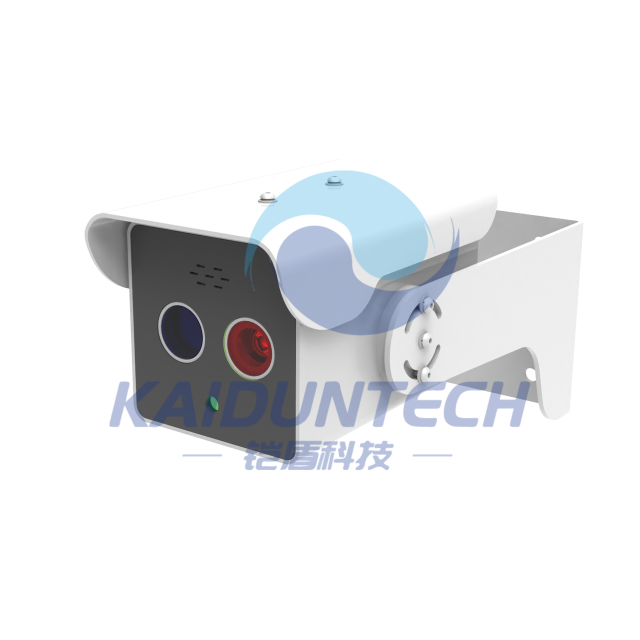
At three in the morning, with fog on the water and spray running across an open deck, the visible picture is a grey rectangle and very little else. A person standing at the rail is still warmer than the steel beside them, and that difference is what this camera works from. A 640 × 512 thermal core and a 4MP visible sensor share one stainless-steel bullet body, so a watchkeeper gets a heat picture and a colour picture of the same spot on a single screen. Thermal coverage normally means a second camera, a second bracket and a second cable run, which is usually where the scope gets cut on a retrofit. A dual-spectrum camera removes that second run: one housing, one network drop, and both pictures land on the recorder already in the rack. Daylight belongs to the visible channel: colour, clothing, markings, which door is standing open. Night, fog and glare belong to the thermal channel, where a warm body against cold steel is unmistakable even when the visible image holds nothing at all. Running the two together keeps a fixed watch position producing evidence through the night without adding deck lighting. A marine standard camera is judged on the same things, and this housing is sealed, impact rated and free of wipers, zoom motors or other moving parts to service between surveys. Shipyards fitting out a newbuild, offshore operators adding night coverage to an unmanned module, and plant security teams watching a tunnel or a waste-handling area all ask the same first question: will the picture still be useful when the light goes. The second question is who stands behind the unit when the surveyor asks for paperwork, and that is where the choice of security camera supplier starts to matter.
Imaging Performance
- 640 × 512 thermal core — A thermal bullet camera lives or dies on its detector, and this one uses a 12 µm pitch core, so the image algorithm holds a longer, cleaner heat picture: a person at the far end of a deck still reads as a person rather than a smudge.
- 4MP visible channel — A 65° × 50° field of view covers a working area in colour, which is what identification needs: clothing, equipment, markings, and which hatch was opened.
- Two views of the same scene — A thermal event can be checked against the colour image before anyone is sent out, so the deck crew is not turned out for a warm exhaust or a hot pipe.
- Tripwire and area intrusion on the thermal channel — Smart event analysis keeps working when the visible image is black, and occlusion detection flags a lens that has been sprayed, covered or blocked.
- Temperature measurement and fire detection — Professional temperature measurement tools and a smart fire-detecting algorithm raise a warning as a hot spot builds, before there is any flame to see.
- Visible and thermal together, around the clock — On a dual-spectrum camera the two channels are not alternatives; they cover the same fixed position day and night, which is how a single mounting point answers a 24/7 monitoring requirement.
Housing & Environmental Resistance
The enclosure is stainless steel 316L, the grade that holds up in chloride-bearing air, with a powder-coated finish available as a second barrier between the metal and the salt. That combination is what separates an anti-corrosion camera from a coated mild-steel box that looks the same on a quotation.
Sealing is rated IP66, so the housing takes driven rain, spray and a wash-down hose without letting water reach the optics. Impact protection is IK10, which matters where hoses, cargo-handling gear and tools meet the camera more often than anyone plans for.
The optical window is nano glass rather than a polymer cover. Polymer hazes and yellows under UV and picks up fine scratches from grit and cleaning; glass keeps its transmission, so the thermal and visible images are as clean in year three as they were at commissioning.
Operation is rated from −40 °C to +70 °C — a sun-loaded deck in the Gulf and a cold-store approach in a northern winter both sit inside that band. If your mounting point sits outside it, next to a flare, an exhaust or a freezer discharge, tell us before the order so the position can be reviewed.
Salt crust is normal on any deck camera and harmless if it is rinsed off; a fresh-water wash after a long passage keeps the coating and the seals in good order. Check the window at each survey for spray residue or impact damage: a classification society approval camera is worth little behind a dirty window, and image quality is lost long before the unit fails.
Mounting, Dimensions & Installation
- Choose the sightline first.
- Ceiling installation is the standard arrangement, with wall and column positions used where the structure gives a better view; for outdoor positions on deck, quay or plant steelwork, pick the face that sees the whole area rather than the one that is easiest to reach.
- Check the envelope against the structure.
- The overall size and weight are in the specification table above and include the bracket, so leave clearance behind the housing for the cable bend and make sure the fixing surface is solid steelwork rather than insulation cladding.
- Fix the bracket, then hang the housing.
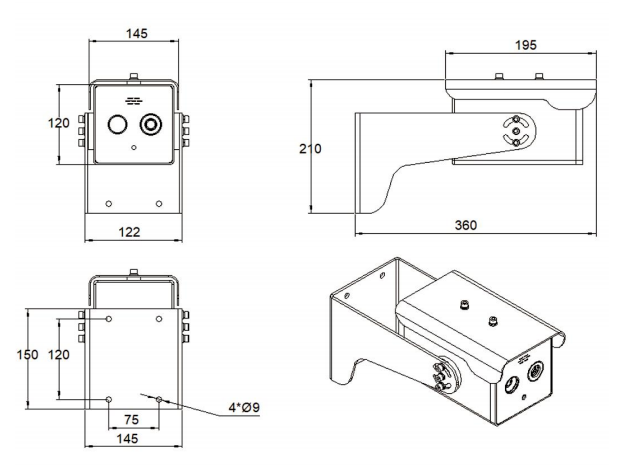
- The dimension drawing marks the fixing positions in the bracket; drill from the drawing rather than from the unit, fit sealing washers so the fastenings last as long as the anti-corrosion camera body, and plan the lift — this is a two-person job at deck height.
- Route the cable with a drip loop.
- Water runs down a cable and into a gland given the chance, so form a low point below the entry before it turns up into the housing; where the installation calls for it, terminate into the matching junction box rather than a field-made joint.
- Connect one power source.
- DC12V and PoE are both supported and either will run the unit, but not both at once; PoE keeps the position to a single cable where the switch can supply it.
- Aim, lock and check both channels.
- The lenses are fixed focus, so there is nothing to zoom: frame the scene once, confirm the thermal and visible views cover the same ground, lock the bracket, and look at the picture on the recorder before the team leaves the deck.
System Integration
- Bring power up first.
- Once the supply at the panel is live, confirm the link before going any further; a camera reached over a switch that has not yet been powered is the most common false fault on a newbuild.
- Point the stream at the recorder.
- The camera delivers IP video over standard ONVIF protocols, so it can sit on the NVR and software you already run instead of a dedicated thermal recorder.
- Use the SDK where the platform needs it.
- SDK access and the accompanying NVR and software are there for integrators who want thermal events inside a wider vessel or plant platform rather than on a separate screen — a common starting point for marine cctv cameras system solutions.
- Wire the alarm contacts.
- Alarm input and alarm output are both provided, alongside sound, so the camera can be tied into an existing sound-and-light alarm instead of reporting only to a monitor.
- Set the linkage rules.
- Multiple event linkage lets one detection start recording, call the sound output and close the alarm output together; agree that logic with the control room before the settings are locked.
- Record the handover.
- Note the IP address, stream settings, rule screenshots and the alarm wiring in the commissioning file — the next surveyor or ETO will ask for exactly that, and a classification society approval camera is easier to sign off when the answers are already in one place.
Typical Deployments
- Deck and superstructure watch on container and bulk carriers — Mooring stations, gangways and deck edges are where a night intruder or a crew member in trouble shows up first, and a warm body against cold steel is the clearest signal the thermal channel has to offer.
- Offshore platforms and FPSO units — Unmanned modules, flare areas and the seaward perimeter are watched from a control room rather than by someone on the walkway, so a marine standard camera has to work in total darkness, in spray and at whatever temperature the deck reaches.
- Tanker cargo decks — Where the deck is watched from the bridge at night and the housing sits in a permanent salt-and-vapour atmosphere, an anti-corrosion camera body and a thermal channel cut down how often someone has to go out and look.
- Tunnels and enclosed roadways — Headlights and sodium lighting flatten a visible image; the heat from people, vehicles and stalled engines stays readable on the thermal channel.
- Heavy industry and smelters — Hot product, molten metal and furnaces swamp a normal camera's exposure, while the thermal channel separates a person from a hot load.
- Waste management and incinerator plants — Night operation, dust and warm loads, on a site where the camera is often the only watch kept after dark.
- Shipyards and outfitting quays — Temporary positions during a refit, where a camera goes up for a few weeks and then moves onto the vessel with the rest of the equipment.
Specifications
| Material | Stainless Steel 316L |
| Protection class | IP66 |
| Surface | Powder coating |
| Thermal resolution | 640*512 |
| Thermal focal length | 13mm |
| Visible resolution | 4MP |
| Visible focal length | 6mm |
| Image sensor | 12.8” progressive Scan CMOS |
| Field of view | 65° × 50° |
| Functions | Motion detection,occlusion detection,sound,alarm input and alarm output |
| Voltage | DC12V/POE power optional |
| Video | IP |
| Weight | ≤7kg |
| Dimensions (L × W × H) | 360 × 145 × 210 mm |
Ordering & Delivery
- Confirm the scope.
- The camera can be ordered on its own or with the matched SS316L Exe type junction box and flexible conduit; the choice changes the packing and the price, so settle it at enquiry stage rather than at the quay.
- Confirm the finish.
- The powder-coated surface can be specified for your project, and a coated housing ages differently from plain 316L; check the shade against your deck schedule if appearance matters to the owner.
- Confirm the power at the cabinet.
- DC12V or PoE — tell us which your panel or switch provides and how long the run is, since that decides whether anything else is needed at the cabinet end.
- Confirm the mounting detail.
- Ceiling, wall or column, the structure you are fixing to, and whether the bracket supplied suits it; ask for the fixing detail for your structure before the installation date.
- Send the paperwork requirement with the order.
- Tell us which society your surveyor names and which documents they expect on file, so the paperwork is prepared with the unit rather than after it.
- Agree packing, shipping and lead time with your sales contact.
- As a security camera supplier we build to project schedules rather than to a shelf.
- Marine cctv cameras system solutions are usually staged with the rest of the package, so confirm dates and terms in writing against your milestone plan.
- The MC465T02 is a CCS type approval camera, carrying the document a yard or owner needs when the unit goes onto the equipment list for a newbuild or a refit.
- The thermal payload is built into the same housing, rather than a visible camera with a second thermal head bolted alongside and approved separately.
- When a tender or an equipment list asks for the certificate copy, it is usually the first attachment the buyer is asked for and the last thing a trading supplier can produce.
- Ask for the copy that matches the unit and the society on your project, and check its scope against your vessel type before the list is frozen.
- Datasheet, wiring detail and the certificate copy are the three documents that travel with a marine package.
- Tell us which society, which project and which language your submittal needs, and the set will be prepared around it; a marine standard camera is only as useful as the paperwork that arrives with it.
- Matched accessories belong to the same conversation: the SS316L Exe type junction box and the explosion-proof and anti-corrosion flexible conduit are the parts that keep a termination sealed and correctly rated where the cable leaves the camera.
- Neither is automatically part of the camera order, so settle the scope when you ask for the quotation.
- For a vessel or a plant that needs more than one camera, this unit fits into wider marine cctv cameras system solutions — cameras, junction boxes, conduit, recorders and operator software — so thermal and visible pictures land on the same screen and follow the same recording policy.
Technical Support & Model Matching
Tell us your site conditions, hazardous-zone classification, the distances you need to cover and whether the project calls for a CCS type approval camera, and our engineering team will help you match the right model and configuration before you place an order. Our R&D team, in-house assembly workshop and finished-product testing area take every unit through a 72-hour test before delivery, while our network of 50 overseas strategic partners can advise on local installation and commissioning. Troubleshooting is handled around the clock, 365 days a year.
FAQ
What does the camera see when the deck is completely dark?
Heat, not light. On a thermal bullet camera the picture is built from temperature difference, so a person, a running engine or a warm exhaust stands out against cold steel even with every deck light switched off. The 640 × 512 core is what gives that image enough detail to act on.
Do we need two cables and two recorders for the two channels?
No. Both channels leave the camera as IP video over a single network connection, and the unit speaks standard ONVIF protocols, so it can record onto the NVR you already run. One drop, one address, one recording policy.
How closely do the thermal and visible views line up?
They cover the same position but not the same angle: the visible channel takes in the wider view, while the thermal lens looks into a narrower cone inside it. On a dual-spectrum camera that is deliberate — the thermal channel watches the approach and the visible channel identifies what is there — and the small offset between the lens centres only matters at very close range.
Can it trigger our existing sound-and-light alarm?
Alarm input and alarm output are both provided and the sound output can be included in the event linkage, so a tripwire or intrusion event can drive an alarm you already have. Send us the panel detail and we will confirm the wiring before commissioning.
How should the optical window be cleaned?
Fresh water and a soft cloth, the same as you would treat any coated glass. Do not use abrasive pads or solvent on the nano glass window, and do not hold a high-pressure jet against the seal line.
Will our surveyor accept a classification society approval camera on this vessel?
Yes — the unit is one of the CCS type approval cameras, supplied with the documentation your surveyor needs. Send us the society, the vessel type and the documents they want on file, and we will confirm the scope covers your project.